
The Smith machine bench press often sits at the center of a heated gym debate, where purists dismiss it as
The post Smith Machine Bench Press: Definitive Guide to Form, Safety, and Science appeared first on Life Fit India.
The Smith machine bench press often sits at the center of a heated gym debate, where purists dismiss it as “cheating” while bodybuilders swear by its ability to target the chest. The truth is not a binary choice between effective and ineffective. The Smith machine is not a replacement for the barbell, but rather a precision instrument for hypertrophy that requires a specific understanding of mechanics to be used effectively.
This piece of equipment offers a vital safety net for the solo lifter and provides a method for advanced athletes to accumulate volume without stabilizer fatigue. This guide moves beyond the basics to explore the biomechanics, hardware logistics, and execution details needed to turn the Smith machine into a powerful asset.
Table of contents
- Smith Machine Bench Press Hardware Guide: What You Must Know
- Smith Machine Bench Press Biomechanics & Muscle Activation
- How to Do the Smith Machine Bench Press (Step-by-Step)
- Smith Machine Bench Press Variations & Programming
- Smith Machine Bench Press FAQ
- Smith Machine vs Barbell Bench Press Muscle Activation
Smith Machine Bench Press Hardware Guide: What You Must Know
Lifters often fail to see results with the Smith machine or experience shoulder pain because of a fundamental misunderstanding of the hardware. Not all Smith machines are created equal, so knowing your equipment is the first step to safety.
Straight vs Angled Machines
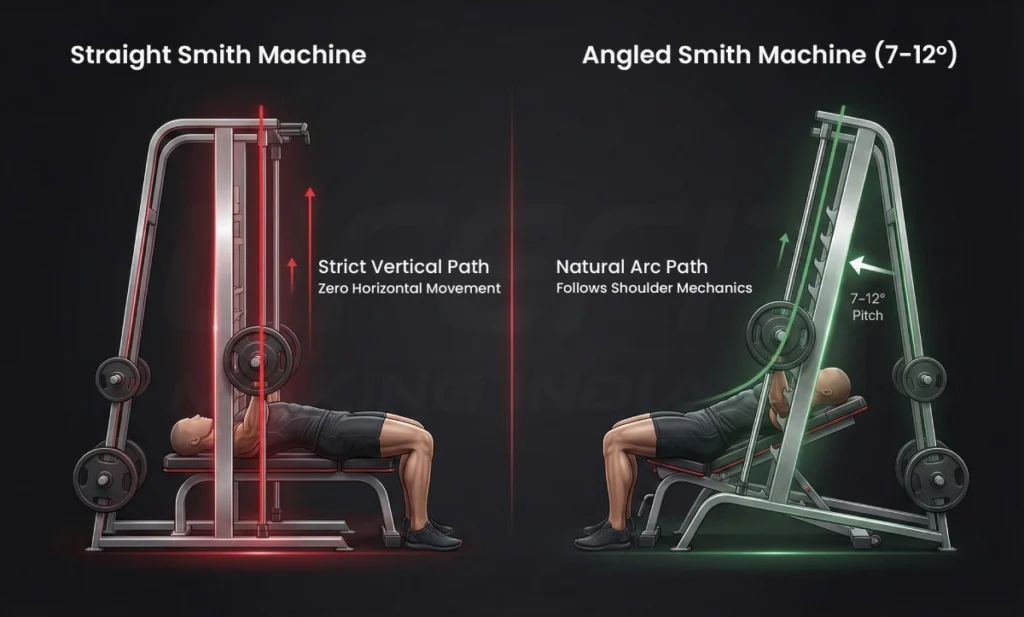
Walking into a gym, you may encounter machines operating on either a perfectly vertical track or a slightly angled one pitched between 7 and 12 degrees. This distinction is critical for your setup.
If you use an angled machine, you must orient the bench correctly because the natural pressing path of the shoulder follows a slight curve back toward the face. When setting up an Adjustable Gym Bench Press, ensure the bar travels back over your eyes as you press up. You are facing the wrong way if the bar travels forward toward your feet, which places excessive shear stress on the shoulder joint.
The Counterbalance Factor
The weight of the bar itself causes significant confusion. While a standard Barbell Bench Press uses a bar weighing exactly 20 kg, the Smith machine involves friction and counterbalance systems that change the load.
Commercial machines often utilize a hidden pulley system to offset the bar’s weight, reducing the starting load to as little as 6 to 9 kg. Conversely, home gym setups often lack this system, meaning you lift the true weight of the steel bar which can be 20 kg or more. You must understand this variable to ensure accurate progressive overload.
Table: Common Smith Machine Bar Weights
| Machine Type | Counterbalance System? | Estimated Starting Weight | Common Locations |
|---|---|---|---|
| Commercial (Life Fit/Matrix) | Yes | 15 – 20 lbs (7 – 9 kg) | Planet Fitness, Commercial Gyms |
| Plate-Loaded (Hammer Strength) | Partial/None | 20 – 30 lbs (9 – 14 kg) | Bodybuilding Gyms, Gold’s Gym |
| Home Gym / Residential | No | 30 – 45 lbs (14 – 20 kg) | Home Gym Setups |
| Old School / Linear Bearing | No | 45 – 55 lbs (20 – 25 kg) | Older Facilities |
Smith Machine Bench Press Biomechanics & Muscle Activation
We must separate gym myths from biomechanical reality regarding muscle activation and strength standards.
The Isolation Myth vs Reality
Many believe the Smith machine “isolates” the chest better than free weights because the machine handles stabilization, theoretically forcing the pecs to work harder.
Schick et al. (2010) conducted a rigorous comparison of muscle activation between a Smith machine and free weight bench press which revealed a different reality. The researchers found that activation of the pectoralis major was similar between the two movements, but activation of the medial deltoid was significantly lower in the Smith machine press.
The implication is clear: the Smith machine does not intrinsically make the chest work harder, but it simply spares the shoulders from heavy stabilizing work. This makes it an excellent choice for a secondary lift where you can accumulate chest volume without taxing already fatigued shoulder stabilizers.
Force Production and the 1RM Discrepancy
Lifters often expect to lift more weight on a machine, yet many find their numbers lower on a Smith machine compared to a barbell. Research on comparison of muscle force production by Cotterman et al. (2005) explains why this occurs.
A natural bench press follows a “Reverse C” path that optimizes the leverage of the shoulder joints, whereas the Smith machine forces a strictly linear path. This constraint can place the lifter in a mechanically difficult position at specific points in the range of motion, often resulting in a lower one-repetition maximum. Do not be discouraged if your numbers differ from your free weight performance.
How to Do the Smith Machine Bench Press (Step-by-Step)
Proper form is non-negotiable because the fixed path of the machine requires absolute precision. Follow this protocol to maximize smith machine bench press safety and efficiency.
- The Setup
Place a flat or Olympic Incline Bench in the center of the machine and align the bar with your nipple line. If using an angled machine, double-check that the path tracks back toward your face.
- The Safety Stops
This is the most critical step for the solo lifter. Disengage the hook and lower the bar to your chest height, then set the adjustable safety stops about one inch above this level. This allows you to bench press safely to failure without a spotter.
- The Grip
Grasp the bar slightly wider than shoulder-width. Some lifters utilize a thumbless grip, also known as the “suicide grip,” to reduce forearm involvement, but this carries inherent risks. A full grip is always recommended for maximum safety.
- The Un-rack
Press the bar up and rotate your wrists back to disengage the hooks. Ensure your wrists are stacked directly over your elbows to prevent unnecessary joint strain.
- The Descent
Lower the bar under control, taking three full seconds for the descent. Do not let the bar bounce off your chest because the fixed path makes impact forces dangerous to the sternum.
- The Press
Drive the bar upward explosively and stop just short of locking out your elbows. This maintains constant tension on the pectoral muscles, maximizing “Time Under Tension” which is highly effective for hypertrophy.
Smith Machine Bench Press Variations & Programming
Master the flat press first, then utilize the stability of the Smith Machine with Dual Pulley for specific needs.
Incline Smith Machine Press
Set your bench to a 30 or 45-degree angle to shift focus to the upper head of the pecs. This is often safer than the free-weight Incline Bench Press for lifters who struggle to stabilize heavy dumbbells overhead.
Reverse Grip Bench Press
The Smith machine is ideal for the reverse grip press, a variation that significantly increases upper chest activation. Performing this with a free barbell can be unstable, but the guided rails make it a safe “hack” for upper chest development.
The Guillotine Press
This advanced variation involves lowering the bar to the neck to stretch the pectoral fibers maximally. Popularized by legendary trainer Vince Gironda, this technique is highly effective but risky. Setting the safety stops is mandatory if you attempt this on a Smith machine to prevent injury to the trachea.
Rehabilitation and Pre-Exhaustion
The fixed path is valuable for rehabilitation because athletes recovering from injuries can press with a controlled range of motion. Bodybuilders also use it for pre-exhaustion by performing isolation movements like the Pec Deck Fly first, then moving to the Smith press to fatigue the chest fully without the risk of dropping weights.
Smith Machine Bench Press FAQ
How much does the Smith machine bar weigh?
Weights vary by brand, with commercial machines often starting at 15 to 20 lbs due to counterbalances while home units can weigh 30 to 45 lbs. Research on counterbalance systems shows these mechanisms significantly alter force production metrics.
Is the Smith machine bad for your shoulders?
Not inherently, but the fixed path restricts natural joint adjustments. Ensure your setup is perfect, avoid flaring your elbows, and never force a painful range of motion. Incorporate Chest Dips to maintain shoulder health.
Can I bench press without a spotter?
Yes, this is a primary advantage of the machine. Once you engage the safety catches, you can train to failure safely, which is excellent for those who train alone in a home gym.
{
“@context”: “”,
“@type”: “FAQPage”,
“mainEntity”: [
{
“@type”: “Question”,
“name”: “How much does the Smith machine bar weigh?”,
“acceptedAnswer”: {
“@type”: “Answer”,
“text”: “
Weights vary by brand, with commercial machines often starting at 15 to 20 lbs due to counterbalances while home units can weigh 30 to 45 lbs. Research on counterbalance systems shows these mechanisms significantly alter force production metrics.
”
}
}
, {
“@type”: “Question”,
“name”: “Is the Smith machine bad for your shoulders?”,
“acceptedAnswer”: {
“@type”: “Answer”,
“text”: “
Not inherently, but the fixed path restricts natural joint adjustments. Ensure your setup is perfect, avoid flaring your elbows, and never force a painful range of motion. Incorporate Chest Dips to maintain shoulder health.
”
}
}
, {
“@type”: “Question”,
“name”: “Can I bench press without a spotter?”,
“acceptedAnswer”: {
“@type”: “Answer”,
“text”: “
Yes, this is a primary advantage of the machine. Once you engage the safety catches, you can train to failure safely, which is excellent for those who train alone in a home gym.
”
}
}
]
}
Smith Machine vs Barbell Bench Press Muscle Activation
Understanding the trade-offs between machines and free weights helps design a balanced routine.
| Muscle Group | Smith Machine Activation | Free Weight Activation | Role in Movement |
|---|---|---|---|
| Pectoralis Major | High (Equal to FW) | High (Equal to Smith) | Prime Mover |
| Anterior Deltoid | Moderate | Moderate | Prime Mover / Stabilizer |
| Medial Deltoid | Low | High | Dynamic Stabilizer |
| Biceps Brachii | Low | High (Stabilizer) | Dynamic Stabilizer |
| Triceps Brachii | Moderate | Moderate | Synergist |
The Smith machine bench press is neither a cheat code nor a waste of time. It is a specialized tool that allows for safe and high-volume training when used with proper form and an understanding of its mechanics. Integrate it intelligently alongside free weight movements like the Flat Bench Dumbbell Press to build a complete and powerful physique.
The post Smith Machine Bench Press: Definitive Guide to Form, Safety, and Science appeared first on Life Fit India.