
If you’ve been training your chest and still struggle to see that defined upper “shelf,” the issue might not be
The post Incline Cable Fly Exercise: What It Is, Benefits, Variations & Form Guide appeared first on Life Fit India.
The term “Iron Cross” immediately conjures images of Olympic gymnasts holding a static T-position on the rings, a feat requiring immense tendon strength and stability.
However, in the realm of bodybuilding and physique development, the Cable Iron Cross is a distinct, mechanically sophisticated movement designed to target the sternal fibers of the chest.
It is not merely a catchy name for a cable fly; it is a biomechanical variation that alters the resistance curve to maximize hypertrophy.
While the gymnastics variation relies on holding body weight against gravity, the cable variation reverses the resistance vector. This guide explores the “Superior Framework” for mastering this exercise, moving beyond generic instruction to provide a deep analysis of anatomy, physics, and execution.
Table of contents
Anatomy & Biomechanics of the Cable Iron Cross
To master this movement, we must first understand the mechanical principles and anatomical targets that distinguish it from standard chest exercises.
Origins of the Iron Cross in Bodybuilding
The Iron Cross originated in Men’s Artistic Gymnastics as a display of static strength. It requires the athlete to hold their body in a cruciform position on the rings.
In the gym, bodybuilders adapted this position using cables to replicate the mechanical advantage of the wide arm position without the need to support their entire body weight. This evolution allowed for the benefits of the wide-angle tension to be applied to hypertrophy training.
Biomechanics of Torque in the Cable Iron Cross
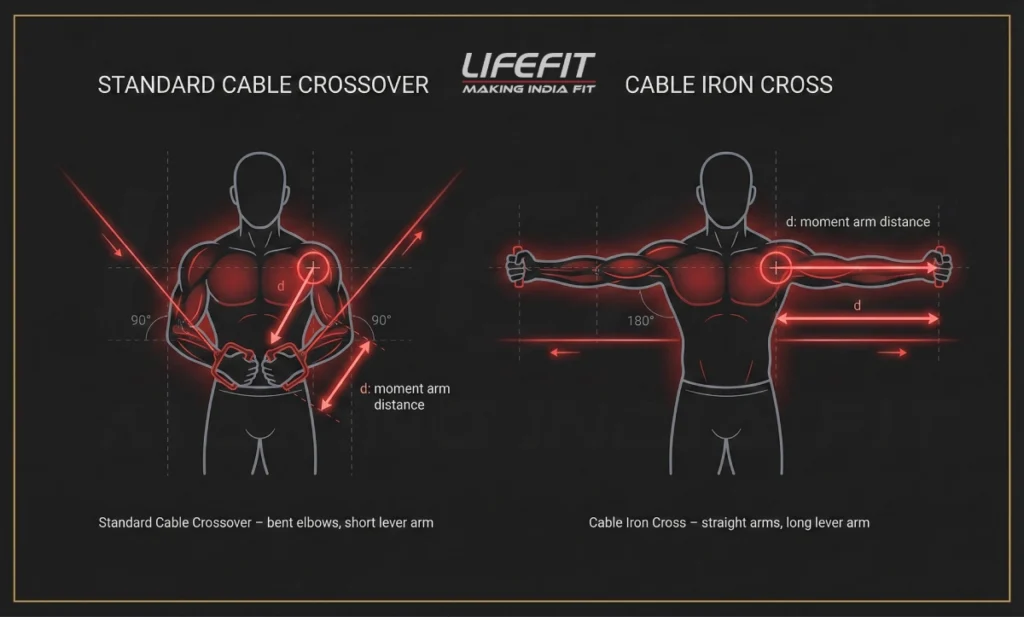
To understand why the Cable Iron Cross is superior for isolation, one must understand the physics of torque. Torque is defined as Force multiplied by the Distance from the axis of rotation, which is the shoulder joint.
In a standard standing cable fly, lifters often bend their elbows significantly to move more weight. This shortens the lever arm and reduces the actual torque placed on the pectorals.
The defining characteristic of the Cable Iron Cross is the extended lever arm. By keeping the elbows locked or near-locked in a “T” position or abduction, you maximize the distance from the shoulder.
This means that a lighter weight creates significantly more tension on the muscle fibers. Research indicates that the moment arm is longest when the pecs are fully stretched, which makes this exercise mechanically disadvantageous for the lifter but highly effective for the muscle.
Muscle Activation of the Sternal Pectoralis Major
The primary target of this movement is the sternocostal head of the pectoralis major. Unlike incline movements that target the clavicular or upper head, the Iron Cross, typically performed with pulleys set at shoulder height, aligns the line of pull directly with the sternal fibers.
Studies on pectoral mechanics suggest that the sternal portion of the pectoralis major shows greater activation during movements that emphasize horizontal adduction, which is the primary function of this exercise.
Advanced Anatomy of the Upper Body Kinetic Chain
While the pecs are the prime movers, the Cable Iron Cross involves a complex kinetic chain.
- Sternoclavicular Joint: This joint acts as the pivot point for the entire movement.
- Coracobrachialis: This small muscle assists in adduction and stabilizes the humeral head.
- Rotator Cuff: The supraspinatus, infraspinatus, and subscapularis work extensively to stabilize the shoulder joint. The cuff must work to keep the ball of the humerus centered in the socket while the pecs generate massive force.
Cable Iron Cross Equipment Setup
Proper setup is critical to prevent the movement from degrading into a press. The choice of machine and configuration can significantly impact the resistance profile.
Machine Selection for Equipment Setup
Choosing the right machine affects the resistance profile. A functional trainer typically has pulleys that are closer together.
This is excellent for pressing movements but may result in a loss of tension at the very end of the Iron Cross range of motion. A traditional wide crossover station maintains a more lateral pull vector even when the hands are close together, ensuring peak tension at the point of contraction.
For lifters who struggle with cable setups or lack access to a crossover station, the pec deck fly machine offers a similar movement pattern with a fixed path of motion, though it removes the stability challenge of the cables.
High Pulley Setup for Chest Isolation
- Pulley Height: Set the pulleys at shoulder height or slightly above. This creates a horizontal line of pull that mimics the gymnastics ring position.
- Handle Choice: While standard D-handles are common, using wrist cuffs can be a superior option. Cuffs eliminate the need for gripping, which reduces forearm activation and allows you to focus purely on the chest contraction.
- The Machine: A wide Cable Crossover station is often preferred over a narrow functional trainer for this specific movement, as the wider pulley stance creates a better stretch at the start of the rep.
How to Perform the Cable Iron Cross
Follow these steps to perform the Cable Iron Cross with biomechanical precision.
- The Staggered Stance
Take a split stance with one foot forward. This provides a stable base to counter the backward pull of the weights.
- The Scapular Set
Before moving your arms, depress and retract your scapula or shoulder blades. Imagine putting your shoulder blades into your back pockets. This stabilizes the glenohumeral joint.
- The Sweep
Keep your elbows locked at approximately 15 degrees of flexion. Do not change this angle during the rep. Sweep your arms forward in a wide arc until your hands meet in front of your hips or lower chest.
- The Isometric Squeeze
Pause for a full two seconds when your hands meet. This utilizes the principle of peak contraction.
- The Eccentric Control
Return the weight slowly, taking 3 to 4 seconds to reach the starting position. Stop when your hands are in line with your shoulders to avoid hyperextension.
Cable Iron Cross Video Demonstration
Common Cable Iron Cross Mistakes to Avoid
The Shrug: Losing Scapular Stability
Many lifters elevate their shoulders or shrug as they fatigue. This shifts the tension to the upper trapezius and increases the risk of impingement. Always keep the shoulders depressed.
The Ego Lift: Sacrificing Form for Weight
Because of the long lever arm, you will need to use significantly less weight than you would for a standard press or even a dumbbell fly. Using too much weight forces you to bend your elbows, turning the isolation movement into a press.
The Head Jut: Compromising Neck Alignment
Pushing the head forward as the hands come together is a common compensation pattern. Keep your cervical spine neutral and your chin tucked.
Cable Iron Cross Programming and Safety
The Cable Iron Cross is an advanced isolation tool. Integrating it correctly ensures maximum growth without compromising joint health.
Hypertrophy Programming and Movement Variations
The Cable Iron Cross is an isolation movement, not a compound power lift like the barbell bench press. It is best programmed for higher repetition ranges to induce metabolic stress.
- Sets: 3 to 4
- Reps: 12 to 15
- Tempo: 2-1-3 (2 seconds concentric, 1 second hold, 3 seconds eccentric)
For those looking to correct muscle imbalances, the Unilateral Iron Cross can be performed one arm at a time. This engages the oblique muscles for core stability.
You can also incorporate static holds, where you maintain the “T” position for time. Evidence suggests that isometric contractions improve tendon stiffness and strength, offering a unique stimulus compared to dynamic reps.
Injury Prevention: Rehabilitation and Shoulder Safety
The name “Iron Cross” carries a reputation for injury risk, particularly to the shoulders. Shoulder injuries in CrossFit often stem from improper form and excessive loading in abducted positions. To perform this movement safely, scapular stability is non-negotiable.
If you have a history of shoulder pain, begin with a thorough warm-up involving band pull-aparts and face pulls. Screening your shoulder mobility using the Hawkins-Kennedy test, ideally under the guidance of a physiotherapist, is advisable before attempting heavy loading.
For those recovering from injury, consult our guide on exercise recovery and consider starting with floor flyes to limit range of motion.
Frequently Asked Questions
Is the Cable Iron Cross better than a standard cable crossover?
The Iron Cross is not necessarily better, but it is mechanically different. The standard crossover often allows for heavier loading because lifters bend their elbows, shortening the lever arm. The Iron Cross uses a straight arm position, creating a longer lever that generates more torque on the pectoralis major with less weight. This makes it superior for isolation but less effective for moving maximum loads.
What specific muscles does the Iron Cross work?
This exercise primarily targets the sternocostal head of the pectoralis major, often called the middle and lower chest. Secondary muscles include the anterior deltoid and the coracobrachialis. Stabilizing muscles such as the serratus anterior and the rotator cuff are also highly active to maintain the shoulder position.
Is the Cable Iron Cross safe for shoulders?
This movement places significant stress on the glenohumeral joint due to the long lever arm. It is generally safe for healthy individuals who adhere to strict form, specifically maintaining scapular depression. However, those with a history of rotator cuff tendinopathy or shoulder impingement should approach this exercise with caution. Always prioritize controlled movement over heavy weight to minimize injury risk.
{
“@context”: “”,
“@type”: “FAQPage”,
“mainEntity”: [
{
“@type”: “Question”,
“name”: “Is the Cable Iron Cross better than a standard cable crossover?”,
“acceptedAnswer”: {
“@type”: “Answer”,
“text”: “
The Iron Cross is not necessarily better, but it is mechanically different. The standard crossover often allows for heavier loading because lifters bend their elbows, shortening the lever arm. The Iron Cross uses a straight arm position, creating a longer lever that generates more torque on the pectoralis major with less weight. This makes it superior for isolation but less effective for moving maximum loads.
”
}
}
, {
“@type”: “Question”,
“name”: “What specific muscles does the Iron Cross work?”,
“acceptedAnswer”: {
“@type”: “Answer”,
“text”: “
This exercise primarily targets the sternocostal head of the pectoralis major, often called the middle and lower chest. Secondary muscles include the anterior deltoid and the coracobrachialis. Stabilizing muscles such as the serratus anterior and the rotator cuff are also highly active to maintain the shoulder position.
”
}
}
, {
“@type”: “Question”,
“name”: “Is the Cable Iron Cross safe for shoulders?”,
“acceptedAnswer”: {
“@type”: “Answer”,
“text”: “
This movement places significant stress on the glenohumeral joint due to the long lever arm. It is generally safe for healthy individuals who adhere to strict form, specifically maintaining scapular depression. However, those with a history of rotator cuff tendinopathy or shoulder impingement should approach this exercise with caution. Always prioritize controlled movement over heavy weight to minimize injury risk.
”
}
}
]
}
By understanding the biomechanics and respecting the leverage disadvantage of the Cable Iron Cross, you can turn this movement into a powerful tool for chest development. It requires leaving your ego at the door and focusing entirely on the quality of the contraction.
For more insights on building a complete physique, explore our workout routines for men or learn about the benefits of other foundational movements like push-ups.
The post Beyond the Fly: Mastering the Cable Iron Cross appeared first on Life Fit India.