
FREE USA KDP GUIDE
Avoid these 7 KDP Category mistakes, before you publish your book!
You have already written the book, formatted it and prepared everything for KDP. Do not let category selection become the confusing final hurdle.
This free guide shows you the mistakes that can waste time, create uncertainty and make category research harder than it needs to be.
- Understand why navigation headings are not always selectable categories
- See why eBook and Paperback category choices should be researched separately
- Learn why the complete KDP selector path matters
Free PDF guide • Immediate access • No obligation
Get the 7-Category Mistakes Guide Now...
Enter your first name and email below to get immediate access to the free PDF guide.
✓ Immediate digital access
✓ Clear, beginner-friendly explanations
No purchase required.
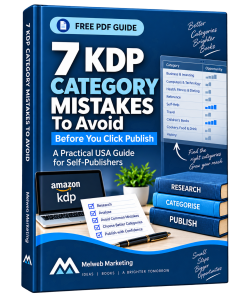 Your free PDF guide
WHAT THIS GUIDE WILL HELP YOU AVOID
A few minutes now could save a lot of category confusion later
KDP category selection looks simple until you start clicking through branches, comparing formats and trying to work out which choices are genuinely selectable. This guide gives you a clearer starting point before you publish.
Below are six of the common mistakes covered. The seventh is explained inside the free PDF itself.
Navigation headings are not always selectable
It is easy to see a heading in KDP and assume you can select it. But navigation steps and selectable placements are not the same. Learn what to check before adding a category to your shortlist.
eBook and Paperback are not identical
A good eBook category path does not guarantee the same route exists for your Paperback. The guide shows why researching the two formats separately can prevent wasted time and wrong assumptions.
Narrower does not automatically mean better
A narrow category can look appealing, but specificity is useless if the fit is weak. Learn why relevance to the actual book should come before chasing the smallest branch.
The full selector path matters
A category name on its own can be misleading. The same or similar wording can sit under different branches, so the full selector path gives you the context you need before choosing.
Structure is not popularity
A bigger tree does not automatically mean more readers, more demand or better sales. Learn to separate category structure from popularity, competition and ranking claims.
One keyword is rarely enough
Searching only the obvious word can hide useful paths. Related wording, synonyms, subject terms and reader language can reveal options you might otherwise miss.